The job posting for the Assistant Vice President for Health and Safety at the University of Minnesota is now open.
Minimum Qualifications:
The Assistant Vice President for University Health & Safety will possess solid credentials in public health and safety administration and should be recognized as an expert in their field.
Minimum qualifications include:
* A master's degree from an accredited institution;
* At least 7 years of experience leading chemical hygiene, biosafety, radiation safety, occupational health & safety, environmental protection, research safety, emergency management, or other health & safety activities, of which 3 years must have been at an upper management level in a large complex organization.
* Successful experience in supervising professional managers and technical staff.
* Possession of one or more of the following professional certifications is preferred:
* Certified Industrial Hygienist (CIH) - American Board of Industrial Hygiene (ABIH)
* Certified Safety Professional (CSP) - Board of Certified Safety Professionals
* Certified Health Physicist (CHP) - American Board of Health Physics
* Certified Hazardous Materials Manager (CHMM) - Institute of Certified Hazardous Materials Managers
* Certified Emergency Manager
* Successful candidates must be eligible to successfully complete a security risk assessment conducted by the U.S. Attorney General/FBI in accordance with CDC/USDA Select Agent Regulations.
Knowledge, Skills, and Abilities:
* Strong interpersonal skills with a demonstrated record of establishing effective working relationships with diverse populations and functions, both internal and external to the organization. A demonstrated ability to work with campus stakeholders to create a culture of safety while accomplishing academic, research, and outreach missions is preferred.
* Demonstrated ability to work closely with local, state, and federal regulatory agencies, in addition to advisory boards, committees, and other policy formulating or recommending groups; evidence of positive performance with regard to responses to inquiries from these agencies.
* Strategic management skills with demonstrated experience formulating and implementing preventative and remedial strategies for a variety of safety, health, and environmental issues as well as emergency management.
* Ability to communicate effectively and articulately in both oral and written communication and have command of enough logic to be able to effectively form a position on an issue, while taking into account multiple perspectives and competing interests.
* Ability to develop professional skills of staff.
* Ability to work cooperatively with faculty, academic administrators and staff to develop new programs consistent with the needs of the institution, including education, record keeping, public relations, and related functions.
* Strong problem solving, analytical, and organizational skills, with the ability to prioritize in a rapidly changing environment.
* Demonstrated understanding of the nature and purpose of health and safety functions within a higher education institution, including building code compliance, occupational health and emergency management, and the inter-relationship of the environment, safety and health in the workplace, laboratories and general campus environment.
* Demonstrated leadership in implementing technology to support organizational strategies within a large and complex organization.
* Personal characteristics which distinguish the incumbent as being an effective leader: team builder, customer-oriented, decisive and result-oriented, and committed to improvement. A management style that entrusts decision-making into the organization with minimal intervention. Possesses both the wisdom and the political savvy to determine which initiatives are important enough to champion and which ones to relinquish.
Duties and Responsibilities:
This position reports to the Vice President for University Services and works collaboratively with faculty, academic administrators, and staff to support excellence while developing and sustaining a culture of safety in compliance with applicable federal, state, and local statutes and regulations/ordinances. The position is responsible for the development, implementation, administration, facilitation, and monitoring of health, safety, and preparedness policies and programs for the University of Minnesota system. It oversees Environmental Health and Safety, Building Code Division, Office of Occupational Health and Safety, Emergency Management.
Responsibilities:
*Directs department resources to mitigate risks and serve the critical safety interests of the University of Minnesota. Has fiscal responsibility for program operating budgets of approximately $10 million dollars and leadership responsibility for 70 positions. In partnership with University administrators and their departments, develops a customer-focused service environment.
*Directs and supports a high-impact and metric-based environmental health and safety program and ensure that it is communicated, embraced, and enforced. Develops and maintains active partnerships with academic and administrative departments across the University system to ensure that the institution's safety and regulatory compliance requirements are met. Ensures access to health and safety resources, timely consultative assistance, management of hazardous substances, and facilitation of prevention efforts.
*Directs and supports the work of the University Building Official and the Building Code Division office. Ensures the administration of the Minnesota State Building Code (MSBC) is integrated with University design and construction standards and the operation and maintenance of University facilities and physical assets in the built environment. Promote the Building Code Division in the delivery of inspection services and business processes on all University campuses.
*Directs and supports the work of the Department of Emergency Management in the development and implementation of emergency preparedness, response, recovery and mitigation efforts. Evaluates and ensures an All-Hazards 24/7 response to emergencies and large scale events between emergency management, environmental health and safety and public safety partners. Ensures system-wide support for emergency management and advises University leadership on emergency preparedness, crisis management, and business continuity and safety.
*Directs and supports the work of the Office of Occupational Health and Safety to promote and protect the health and safety of all employees, students, volunteers, and visitors who participate in activities related to the University's missions of teaching, research, and service. Provides leadership to align the goals and objectives of the Office of Occupational Health and Safety with University policies and procedures in support of University Services strategic plan and the University's mission.
*Serves as the University's responsible official and primary interface with local, state, and federal regulatory agencies.
*Creates a positive work environment, incorporating the University's commitment to equal opportunity and diversity recruitment, retention and promotion of employees, empowering employees to use their full range of talents and abilities. Ensures that annual performance appraisals are completed for all staff in University Health & Safety.
*Serves as a member of the University Services Leadership Team. Contributes to the overall strategic direction of University Services and advises on University-wide strategy as necessary. Leads the formulation and execution of the Department of University Health & Safety strategic work plan in coordination with other University Services units.
Wednesday, June 4, 2014

Thursday, April 24, 2014
Summer Construction Projects at U of MN East and West Bank 2014
Construction Projects Spring trough Summer 2014
Click on picture to enlarge


Thursday, December 19, 2013
Arlo Siemsen, Science & Engineering - The Solar Vehicle Program - 2013 World Solar Challenge, Australia
 |
| Arlo Siemsen - Electronics expert for U of M Solar Car |
Arlo Siemsen gave a talk on the University of Minnesota Solar Vehicle Project. The solar car is designed and built by U of M undergraduates at an approximate cost of $250,000. With many funds donated by local companies.
On October 15, 2013 the vehicle completed the 3,000 kilometer 2013 Bridgestone World Solar Challenge in Australia. It placed 4th in the Cruiser class. Less than 50% of all teams completed the race under their own power.
Fun fact: U of MN DEHS employee David Paulu is a former member of a past U of M Solar Car team.
Video on the 2013 two seat Solar car Daedalus
Monday, December 9, 2013
Dr. Sherrie Flaherty, MDH - MN Radiological Emergency Preparedness Program
 |
| Dr. Sherrie Flaherty |
 |
| http://en.wikipedia.org/wiki/Pressurized_water_reactor |
 |
Prairie Island Power Plant - http://www.mprnews.org/story/2013/03/27/environment/prairie-island-nuclear-plant-getting-additional-inspections |
 |
| Boiling Water Reactor: http://www.nrc.gov/reading-rm/basic-ref/students/animated-bwr.html |
 |
Monticello Power Plant - http://www.mprnews.org/story/2007/01/17/monticelloshut |
Resources:
2011 Emergency Preparedness guide for the Monticello Power plant - Xcel Energy
2013 Emergency Preparedness guide for the Prairie Island Power plant - Xcel Energy
Acronyms:
- REP - Radiation Emergency Preparedness
- EAL - Emergency Action Level
- ECL - Emergency Classification Level
- EPZ - Emergency Planning Zones - 10 mile radius from plant
- GE - General Emergency
- IPZ - Ingestion Planning Zone - 50 mile radius from plant
- NUE - Notice of Unusual Event
- PAR - Protective Action Relocation
- KI - Potassium Iodide
- SAE - Site Area Emergency
Three types of fission byproducts are produced with different half lives
Cesium 134 half life of 2 years
Cesium 137 half life approx. 30 years.
Iodine 131 half life 8 days.
After a confirmed release of radioactive material, individuals within 10 miles of a reactor or are down wind of a nuclear release need to pick up potassium iodide at Target Pharmacy.
>
New Turbine at Prairie Island Plant 2013
Saturday, December 7, 2013
DEHS fall retreat - Connie Weston - Emergency Preparedness for the Medical Lab
 |
| Connie Weston talking with Brian Vetter |
First a handy guide to acronyms:
- ACS - Alternate Care Sites
- C-FLOP - Command, Finance, Logistics, Operations, Planning - IC command structure
- BHPP - Bioterrorism Hospital Preparedness Program
- CERT - Civilian Emergency Response Team
- MHMPC - Metro Health Medical Preparadness Coalition
- MN Responds - Minnesota Medical Reserve Corps
- MNTrac - Minnesota system for Tracking Resources, Alerts and Communication
- MMT - Mobile Medical Team
- MMU - Mobile Medical Unit
- RHRC - Regional Hospital Resource Center
- TOT - Technical Operations Team
Lessons learned from setting up a 1,200 bed ACS site in 2011 at River Center:
- Arm badges don't work well. They are not visible. They slide down the arms. Vests or lanyards work better.
- When setting up a cot secure the latch back or someone may fall out of it.
- Triage areas can be a bottleneck and must be designed to get people processed promptly.
- Communication can be difficult- The battery strength on two way radios will decay over time. The use time on the battery dropped to less than 1/2 hour. They resorted to megaphones and then yelling when the batteries on the megaphones died.
- Need personnel who are focused on problem solving and not focused on the sky is falling.
- Before moving supplies in a mobile lab unit make sure items are latched and secured properly.
- Developing a good system for keeping track of people when they are sent off site for treatment is critical.
- Need security for pharmacy.
Resources:
They have buses available to transport patients either in a seated position or a horizontal position.
There is a mobile 8 bead emergency room available on 48 hour notice. It must be placed in a parking lot or other flat surface area as it needs to be stable. The semi is driven 150 miles a month and maintained by a local technical school.
Minnesota is a leader in taking care of companion animals.
The central Minnesota response team has had recent experience responding to large flood events and was a valuable resource for responders in other parts of the state.
Thursday, December 5, 2013
DEHS fall retreat December 5, 2013 - Fracking with Dr. Larry Wackett

Dr. Larry Wackett Department of Biochemistry, Molecular Biology, and Biophysics spoke on the Fractured Debate on Fracking.
 |
| Shale Plays in the lower 48 United States http://en.wikipedia.org/wiki/Shale_gas_in_the_United_States |
US oil production bottomed out in 2008 but has now increased due to a process known as fracking. The deep (2-4 mile) horizontal wells allow extraction of crude oil and natural gas in areas previously unavailable for removal. Currently, there are approximately 80,000 fracking wells in the US. The map above shows the available shale plays with deposits of oil and natural gas. Fracking operations will also be increasing around the world.
 |
| http://legalectric.org/f/2013/10/fracSandOperations.jpg |
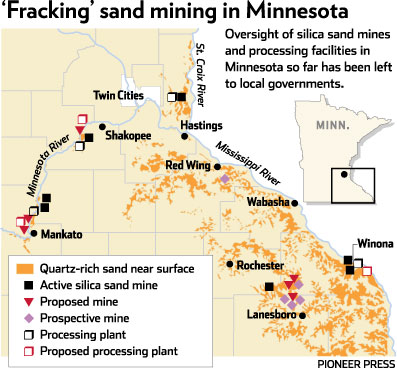
While fracking does not occur in Minnesota, the state along with Wisconsin does provide very high quality sand used in the fracking process. The uniform spheres are the best proppant available to allow for gas and oil to be removed from the horizontal fractures in the well.
The water use in a fracking well is heavy. One fracking well will use the amount of water needed to fill ten Olympic sized swimming pools. The water is injected then removed from the well and placed in settling ponds. Most fracking operations attempt to recycle the water using chemical treatment and filtration.
Dr. Wackett's group has been experimenting with bacteria that breakdown a broad spectrum of chemicals commonly found as contaminants in fracking water. Instead of just adding the bacteria to the solution, the bacteria are encased in permeable silica mesh or silica filters. The bacteria mobility is restricted and they do not reproduce but instead digest the chemicals. In 20 minutes a bacteria can digest a chemical mass equivalent weight of the bacteria. He is looking to develop at least four types of bacteria to breakdown several classes of chemicals including benzene, alkanes, alcohols and polycyclic aromatic compounds.
At present, a similar process has been commercially used to breakdown Atrazine for water treatment in Iowa. The researchers have been attempting to interest companies in field studies to take the experiment out of the laboratory. His lab maintains the Biocatalysis/Biodegredation Database to assist others interested in biodegredation.
Parker Abbot's Summary of a previous lecture by Dr. Wackett on Fracking
Dr. Wacket's lab has also developed an enzyme test for detecting melamine
Tuesday, November 5, 2013
MDH and SPH moving beyond HSEEP (Homeland Security Exercise and Evaluation Program)
The Minnsesota Department of Health and the U of MN School of Public Health have developed training exercises to enhance team effectiveness during public health disasters.
The exercise scenarios:
Political Event; 3-part exercise
Tornado (affects healthcare system); 2-part exercise
Winter Storm
Flash Floods
Tornado (affects summer tourist area); 2-part exercise
Firestorm: a climate change scenario
Click on Disaster 101 training information.
The exercise scenarios:
Political Event; 3-part exercise
Tornado (affects healthcare system); 2-part exercise
Winter Storm
Flash Floods
Tornado (affects summer tourist area); 2-part exercise
Firestorm: a climate change scenario
Click on Disaster 101 training information.
 |
| Snowfall in Minnesota - April 24, 2013 |
Subscribe to:
Posts (Atom)